
Covid-19 caught many organizations and businesses off-guard, who suddenly found themselves facing new and unanticipated challenges requiring rapid and strategic organizational responses. Even in the early stages of the pandemic, it was clear that the "traditional" business continuity and disaster recovery plans did not provide the responses required to effectively manage the effects of the epidemic.
For example, according to a study by the Gartner Institute [1] – in the early stages of the Covid-19 outbreak, one in four organizations was forced to suspend their activities for several days, with a large part of the organization's shutdowns due to a lack of planning & adequate preparations.
At the same time, organizations that built a good and appropriate business continuity plan were in a much better position and were able to respond and adapt to the Covid-19 challenges faster and more effectively than organizations without a plan.
To survive in a rapidly changing world it is important to develop, revise and adapt the business continuity plan based on lessons learned over the past year and prepare for the future.
3. Practices worth adopting for the next year:
- Flexibility – First of all – a good business continuity plan should be flexible and address both difficult-to-anticipate scenarios, as well as dual scenarios (e.g., dealing with a cyber attack during Covid-19). Although many crises cannot be predicted, once the endpoints of different scenarios are isolated, it can be seen that in most cases the impact of the crises on the organization actually increases its resilience. The business continuity plan deals with diverse crises. Prudent use of lessons learned, their integration and application to the entire body will increase its organizational resilience.
Moreover, even if we face an entirely new scenario, which we have never previously dealt with, the insights and knowledge we acquire during the BCP (Business Continuity Plan), planning will save resources in preparing for new scenarios.
2. Adaptation to a new routine – Contrary to popular belief, a large number of crisis events don't end quickly. In practice, crises can last for a long time and completely impact the reality we are familiar with. In these cases, to maintain organizational resilience, one should not strive to return to the previous routine that existed before the crisis but rather to build new procedures adapted to the new reality. A good business continuity plan allows for preparation and adaptation to unknown scenarios and a new routine, which may remain in place for a long time and even change the face of the future.
Tightening the link between the business continuity plan and cyber security – With the outbreak of Covid-19, we witnessed a steep increase in the scope and severity of cyber attacks so that in practice many organizations had to operate on two fronts simultaneously. Ultimately, both a cyber crisis and a business continuity crisis require similar types of crisis management skill sets and tools. Reinforcing the cooperation between the business continuity plan and the cyber security of the organization will lead to a better and more effective understanding of the challenges facing the organization under one overall vision.
Whats next?
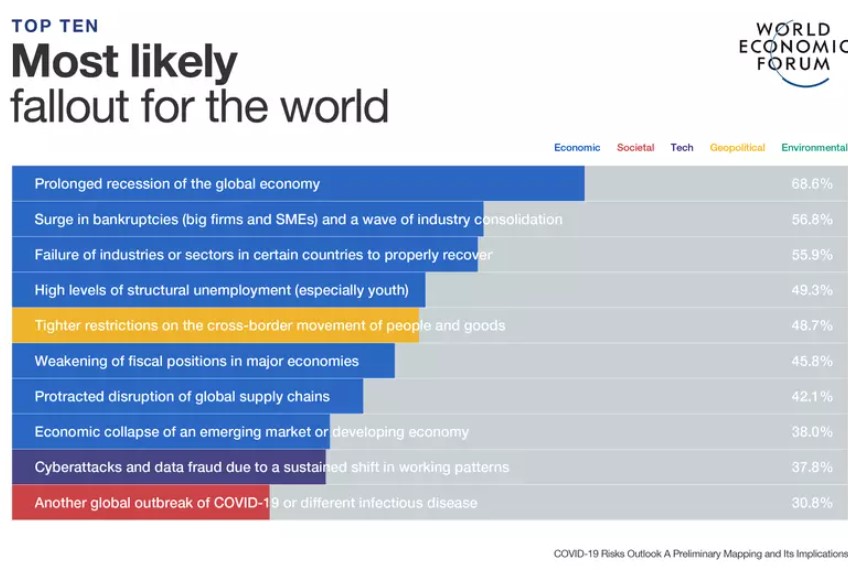
Covid-19 has shaken our world and its impact is expected to continue for many more years. According to the publication of the World Economic Forum [2], these are the main risks expected in the next five years as a result of Covid-19:
- Ongoing global recession
- Increase in bankruptcies and mergers
- Failure of certain sectors, in certain countries, to recover from the crisis
- High unemployment levels (especially among young adults)
- Tighter restrictions on crossing the boundaries of people and goods
- Declining tax revenues in leading economies
- Prolonged disruptions in global supply chains
- Economic collapse of emerging markets or developing economies
- Increased cyber attacks and network scams as a result of the change in work patterns
- Another global outbreak of Covid-19, or another infectious disease
Prepare for the future!
Building a business continuity plan and organizational resilience is necessary to support the organization's activities in a changing world, and their importance is growing in the face of various threats such as terror events, threats, epidemics, cybercrime, civil instability, extreme weather, climate change, and more.
To be prepared to deal with the escalation of these threats, as well as new and unexpected threats, companies and organizations need to build flexible and comprehensive business continuity plans and develop adaptable organizational resilience methodologies at all levels in the organization.
Elements has extensive experience in planning and managing business continuity, organizational resilience, and crisis management in businesses and manufacturing companies. We specialize in helping companies identify their core tasks, and build a plan that will enable those tasks to be accomplished even in difficult and challenging scenarios of vulnerability and resources reduction. In doing so, we have developed a detailed and proven methodology for successfully dealing with these crises.
For more information, please contact us by phone: 072-2650145 | 054-4510982, or via the referral form on the website.